An e-auction can look simple from the outside: a bidder submits an amount, the platform validates it, and the highest eligible bid wins. The difficult engineering starts when many people bid at once, the auction is approaching its deadline, and every connected user expects an accurate update immediately.
A production auction engine must make one defensible decision about each bid, preserve that decision durably, and distribute the result without allowing retries, disconnected clients or application replicas to invent conflicting versions of reality.
This article outlines a practical architecture for real-time auction platforms, drawing on a stack that includes Node.js, React, MySQL/Percona, Redis, Apache Kafka, WebSockets, Docker, Kubernetes and ELK/APM. The focus is on the boundaries and trade-offs—not on claiming that a particular pattern fits every auction or that every advanced capability is already implemented in every system.
1. Start with responsibilities, not technologies
A small bidding application may begin as a browser calling an API that reads and writes a database. As usage grows, the platform must handle concurrent requests, auction schedules, real-time updates, notifications, audit history, retries and multiple application instances.
The first architecture decision is therefore to make responsibilities explicit.
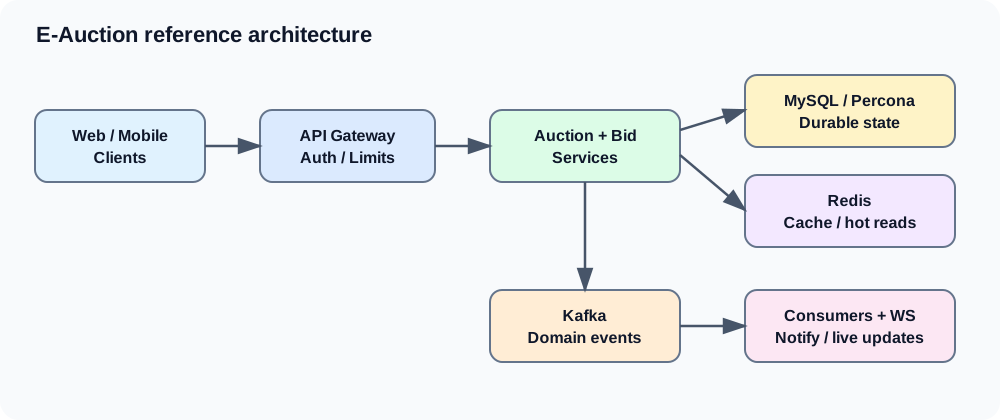
| Component | Responsibility |
|---|---|
| Auction and Bid services | Enforce auction rules and decide whether a bid is accepted |
| MySQL/Percona | Persist authoritative business state and history |
| Redis | Accelerate selected reads and support carefully chosen coordination needs |
| Kafka | Distribute durable events to asynchronous consumers |
| WebSocket layer | Push accepted state changes to connected clients |
| Kubernetes | Run and scale application workloads |
| ELK/APM | Help operators trace requests and diagnose failures |
These are logical responsibilities, not a mandate to deploy every row as a separate microservice. Service boundaries should follow domain ownership and operational needs. Introducing more components without a clear reason can increase failure modes rather than improve the design.
2. Treat the auction lifecycle as server-owned state
An auction is more than an isOpen flag. It moves through business states such as Draft, Scheduled, Open, Closing, Closed, Winner Determined and Settlement. The exact lifecycle depends on the business, but every transition needs a defined owner and policy.
The browser can display a countdown, but the countdown must not decide whether a bid is valid. Client clocks can drift, requests can be delayed, and a user can manipulate client-side code. The server must evaluate the request against the auction's authoritative state and the agreed time policy.
That policy should define which timestamp matters, how the closing boundary is handled, whether extensions are allowed, and how closure interacts with bids already being processed. Those rules should be documented and tested as business behavior rather than left as incidental timing effects.
3. The bid path: validate, serialize, persist
A bid request typically passes through authentication, authorization, bidder eligibility checks, auction-state validation and amount/rule validation. It then enters the concurrency-control mechanism, persists the accepted state, and returns a result to the caller.
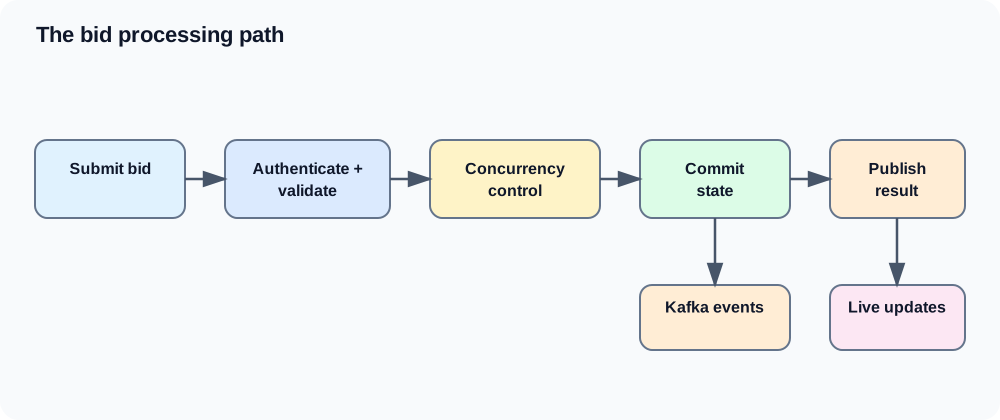
The key boundary is between deciding a bid and announcing that decision. The bid path is synchronous because the caller needs a clear answer. Notifications, analytics and client broadcasts can usually react after the business decision has been committed.
The concurrent-bid race
Suppose the current highest bid is ₹9,000. Bidder A submits ₹10,000 while Bidder B submits ₹10,500. If two API instances independently read ₹9,000 before either writes, each request may appear valid against stale state. Without a concurrency strategy, the final result can depend on the timing of reads and writes rather than on a defined rule.
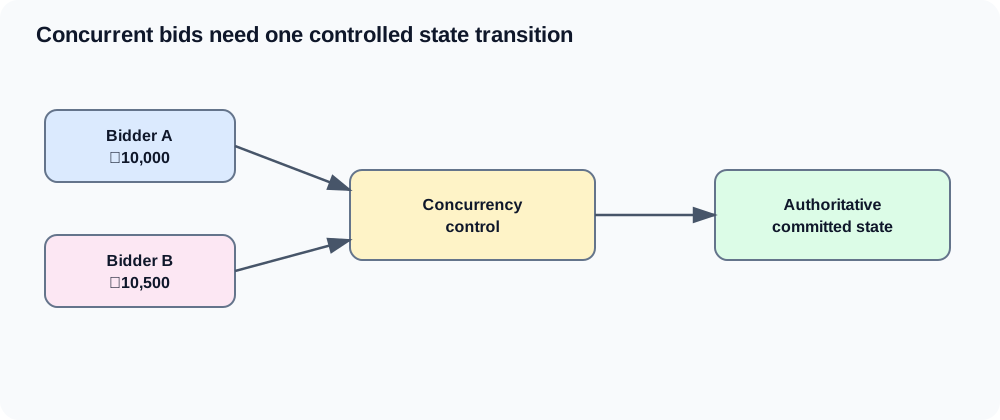
A correct implementation must serialize or otherwise control conflicting changes to the same auction. Depending on the database and processing model, this can involve transactions and row locks, optimistic concurrency with version checks, atomic operations, or partition-aware processing. The mechanism can vary; the invariant cannot:
Two competing requests must not create an impossible auction state merely because they arrived concurrently.
Horizontal scaling does not solve this by itself. More API replicas increase capacity, but they also make shared-state and concurrency decisions more important.
4. Keep durable truth distinct from fast or distributed representations
Redis can be valuable for hot auction data, low-latency reads and selected coordination tasks. It should not automatically become the only record of a business outcome simply because it is fast. The appropriate design depends on durability, consistency and recovery requirements.
Ask a simple question for every stored value: if this value disappears, can it be rebuilt safely from durable records? If it is a derived cache, a rebuild path may be sufficient. If losing it would erase the accepted bid or make the winner impossible to explain, it needs stronger durable treatment.
MySQL or Percona can preserve transactional business state, while Redis provides acceleration where justified. Kafka distributes events; WebSockets deliver updates. These are related roles, but they are not interchangeable sources of truth.
This separation also clarifies failure behavior. A lost WebSocket connection must not undo a bid. A cache miss must not erase business history. A temporarily unavailable Kafka consumer should delay downstream work, not silently change the validity of a bid already committed.
5. Real-time updates with WebSockets
Polling can be adequate for quiet auctions, but frequent polling creates repeated requests even when nothing changes. WebSockets allow the platform to push updates to connected bidders as accepted state changes occur.
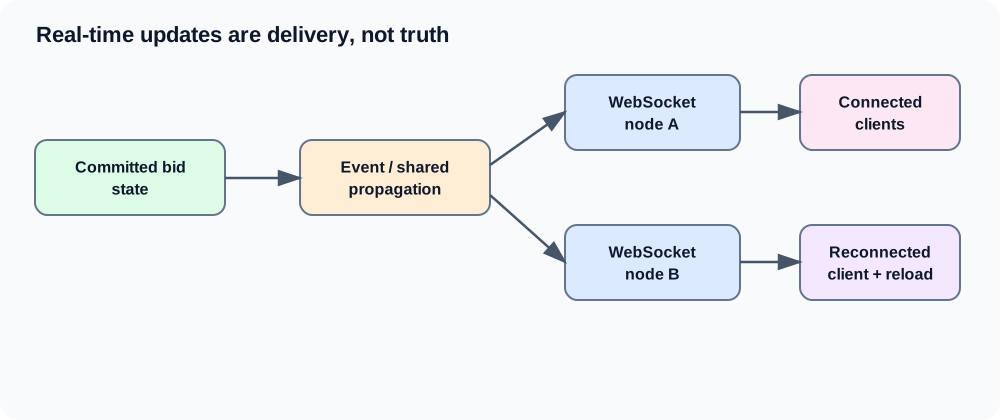
The real-time layer should publish a state change only after the bid decision is committed. It must not independently determine the winner.
Clients also need a recovery path. Browsers disconnect, devices sleep, and messages can be missed while a user is offline. When reconnecting, the client should fetch a fresh snapshot of authoritative auction state and then resume receiving updates. Treat push messages as a fast way to learn about changes, not as the only record of those changes.
When WebSocket connections are spread across several application instances, an update received by one instance must be propagated to the instances that own relevant client connections. That propagation can use a broker or another shared mechanism. The choice depends on traffic, ordering needs and operational complexity.
6. Use Kafka for work that can happen after the decision
A successful bid can trigger several independent actions: notify participants, update reporting projections, write an audit stream, or inform another business service. Putting every action inside the critical request path increases latency and couples bid acceptance to downstream availability.
An event-driven boundary lets the authoritative service publish a domain event such as bid.accepted or auction.closed. Kafka then distributes it to consumers that own their respective work.
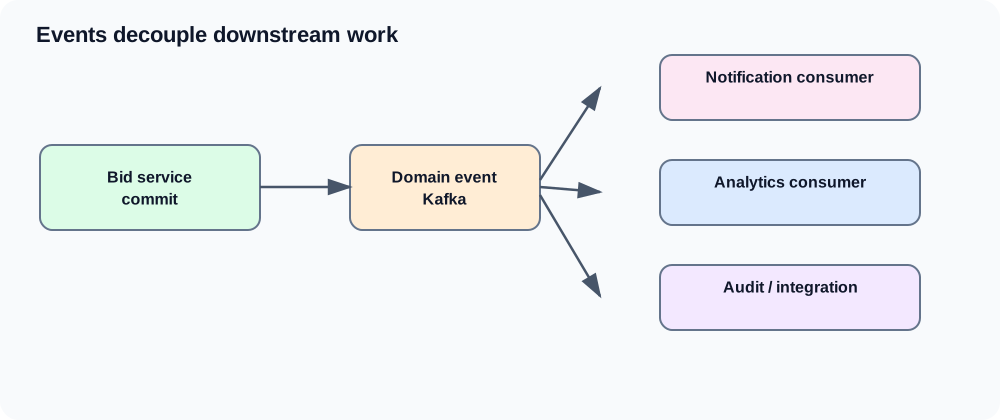
Events should describe meaningful business facts, carry a unique event identifier, include a schema/version and correlation identifier where useful, and avoid unnecessary sensitive data. A message key such as auctionId may help preserve ordering for events belonging to the same auction, because Kafka ordering is guaranteed within a partition rather than globally across a topic.
Do not make everything asynchronous. Bid validation and the durable business decision must finish before the API reports acceptance. Kafka is most useful for work that can react to that decision independently.
What if event publication fails?
A classic failure window exists when the database transaction commits but publishing the corresponding event fails. The bid is accepted, yet notification or analytics consumers never learn about it.
For workflows where losing an event is unacceptable, the Transactional Outbox Pattern is a common option: write the business change and an outbox record in the same database transaction, then have a separate publisher forward pending records to Kafka. Retries and reconciliation can help recover from temporary failures. This is additional machinery, so it should be justified by the business risk rather than applied automatically to every event.
7. Idempotency and recovery are core behavior
Network timeouts do not tell a client whether the server completed the request. A bidder may retry after the first request was accepted but before the response arrived. Without idempotency, the retry can become a second business action.
Give each logical bid request a unique idempotency key and persist enough information to recognize a previously processed request. Repeated submissions with the same key should return the original result rather than create a new bid. The key must be scoped and retained according to a deliberate policy; an in-memory cache alone is not a durable guarantee.
Consumers also need to tolerate redelivery. A consumer might send a notification and crash before committing its Kafka offset. Kafka can deliver the event again after recovery. Producer idempotence protects a particular part of Kafka publishing; it does not guarantee exactly-once effects at an external email, SMS or payment provider.
Use durable deduplication where appropriate, bounded retries for transient failures, clear handling for invalid events, and a dead-letter process that operators actually monitor. A dead-letter topic without ownership, alerts and replay procedures merely hides failures.
8. Auction closing is a business race too
Consider an auction scheduled to close at 10:00:00. One bid arrives just before the deadline; another arrives just after. Whether either bid is eligible depends on the published auction policy and the authoritative ordering of server-side state transitions.
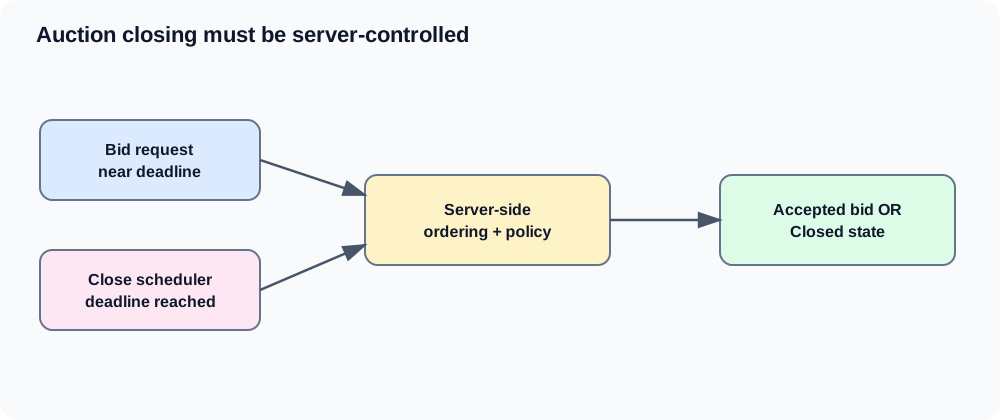
There is no universal rule for every auction. Some systems use server receipt time; others define acceptance around processing or commit order, with explicit extension windows. The platform must define one policy and apply it consistently. A frontend timer is informational only.
Closing should be an explicit state transition that competes safely with bid processing. Tests should cover the boundary, delayed requests, duplicate requests, clock assumptions and extension rules—not just the ordinary case where a bid arrives well before closing.
9. Scale and observe the whole journey
Kubernetes can run multiple API and WebSocket replicas and replace unhealthy instances. But critical state should not live only in process memory, and adding replicas must not bypass the concurrency strategy. Scale each workload according to its own bottleneck: bid processing, open WebSocket connections and event consumers have different capacity characteristics.
Observability should connect the bid request, persistence result, emitted event, consumer processing and client update with a correlation identifier. Useful signals include bid acceptance/rejection counts, request latency, database latency, Redis health, Kafka consumer lag, retry and dead-letter counts, WebSocket connection health and error rates.
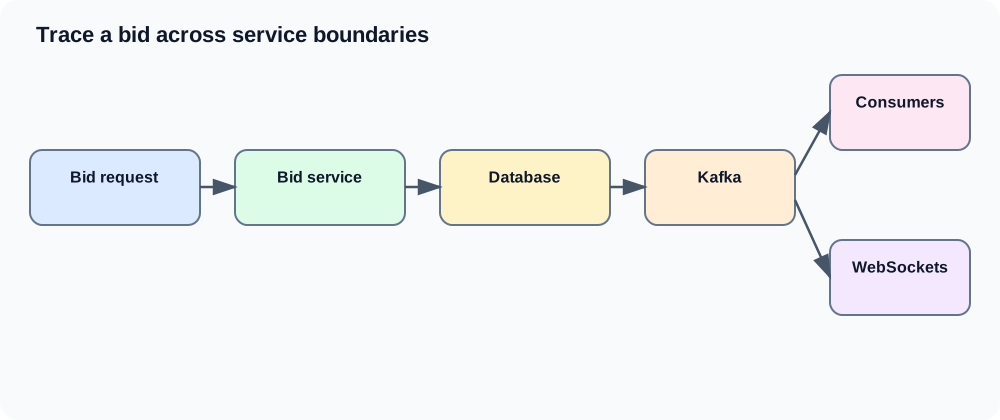
The goal is to answer operational questions quickly: Was the bid received? Why was it rejected? Was it committed? Was its event published? Are consumers behind? Did connected clients receive the update? Structured logs, metrics and traces are more useful than isolated log lines when a workflow crosses several services.
Security belongs at every boundary. Authenticate the bidder, authorize auction participation, validate all business rules on the server, protect administrative actions, secure service-to-service communication, and keep secrets and sensitive recipient data out of places where they are not needed.
10. A practical production-readiness checklist
Before calling an auction engine production-ready, verify that:
- There is a clearly defined authoritative bid state.
- Concurrent bids and auction closure have deterministic rules.
- Duplicate client requests cannot create unintended business effects.
- The server—not the browser—decides eligibility and closing.
- Reconnecting clients can reload current state.
- Cache loss, broker outages and consumer crashes have recovery paths.
- Events can be retried or reconciled where business-critical.
- Consumers tolerate redelivery and retries are bounded.
- Application replicas can scale without relying on local memory for critical state.
- Operators can trace a bid from request through persistence and downstream delivery.
- Access controls, audit history and sensitive-data handling are explicit.
The architecture should evolve with business risk and observed load. A modest platform may not need event sourcing, CQRS, multi-region coordination or a complex partitioning strategy on day one. Add complexity when the consistency, throughput or recovery requirements justify it.
Closing perspective
A scalable e-auction engine is not simply a high-throughput API. It is a distributed system where correctness and authoritative state must remain explicit while real-time communication, asynchronous work and horizontal scaling operate around them.
Use Redis to accelerate suitable access patterns, Kafka to distribute work that need not block the critical path, WebSockets to make committed changes visible, Kubernetes to operate application workloads, and durable storage to preserve business outcomes.
The technology choices matter, but the boundaries matter more.
Scale the infrastructure and distribute the work—but keep responsibility for deciding what actually happened unambiguous.
Related reading
- Handling Concurrent Bids in a Real-Time Auction System — transaction boundaries, idempotency and auction-close races.
- Auction Contention Estimator — model hot-auction throughput and queue pressure.
- Designing an event-driven notification architecture with Apache Kafka — patterns for durable events, retries, idempotency and downstream processing.
- Upgrading Azure AKS safely: production-readiness guide — a practical approach to cluster upgrades, validation and operational risk.
- Securing an Azure origin with Cloudflare and Nginx — edge-to-origin controls and secure application delivery.